도안 목록으로 돌아가기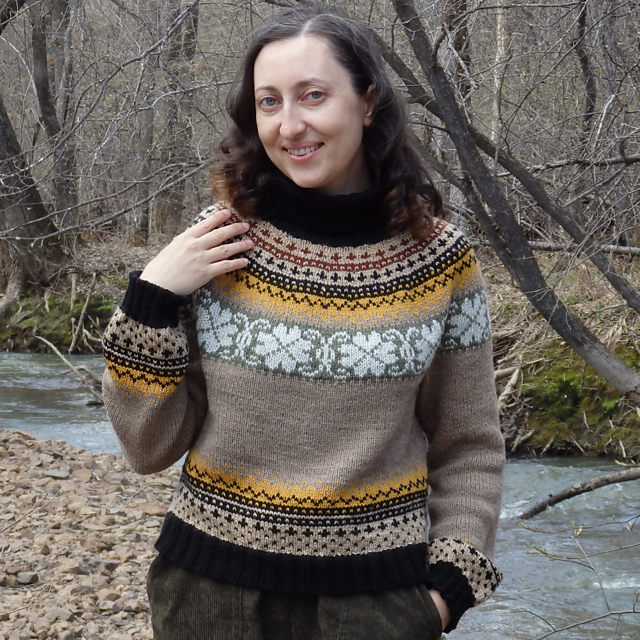
 🪄 도안 확인하기
Pullover무료 도안
Calamagrostis sweater
디자이너: Anya Hawkins
난이도0.0
바늘 크기
4mm
실 굵기중간 실 (6~8합)
(DK (11 wpi))
(DK (11 wpi))
좋아요165
ADVERTISEMENT
도안 상세 설명 구글번역기로 번역하기
**Calamagrostis sweater**
by Anya Hawkins
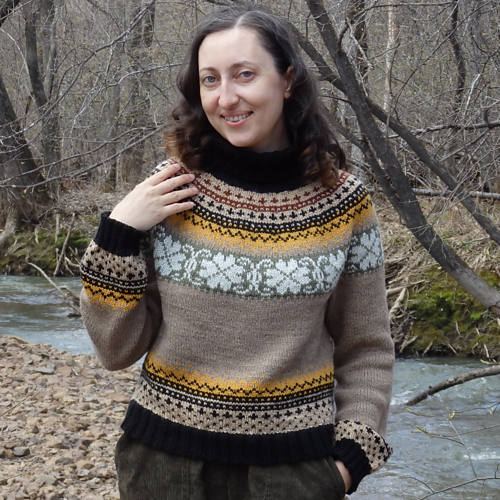
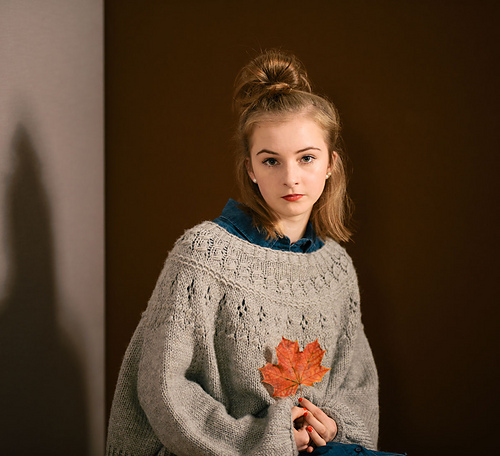
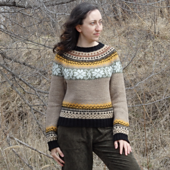
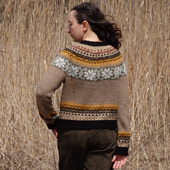
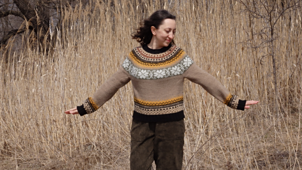
Calamagrostis sweater is a DK weight circular yoke sweater that was inspired by a beautiful river valley overgrown with willows, reeds, and bush grass. On a late autumn day under overcast sky the colors of this landscape acquired unique depth and richness. This color palette was the basis of this design.
The colorwork contains 7 colors – 2 dark colors, 1 very light color and 4 medium. They can be substituted for colors of your choice. And you’ll get very different and unique to you garment.
This sweater has two neck options – neckband and turtleneck. And the fit is adjustable. The pattern contains instructions on how to adjust the fit in four different places. You can control the depth of the yoke, the length of the body, the width of the sleeves and their length.
This pattern also has complete video tutorial accompanying it. Every technique used is shown in great detail.
**Difficulty level**
Brave beginner, intermediate, experienced.
**Techniques used**
Knit, purl, working in the round on circular needles, working small circumferences in the round on DPNs/with magic loop or with two circulars, increases, decreases, stranded colorwork, working from chart, provisional crochet cast on, Backwards Loop cast on, Jeny’s Surprisingly Stretchy bind off (optional).
**Sizes**
1 (2, 3) (4, 5) (6, 7) (8, 9)
Chose a size with approximately 2-4’’ (5-10 cm) of positive ease at chest.
When choosing a size it is also advisable to measure widest part of your arm and compare it to finished upper sleeve circumference from the schematic. There should be at least 1’’ (2.5 cm) of positive ease.
Detailed schematic with all finished measurements is inside the pattern. Smallest size (1) finished chest circumference is 33.2'' (83 cm). Biggest size (9) is 53.6'' (134 cm).
**Yarn**
DK weight (10 wpi) 260-275 yds (240-250 m) per 100 g
**Gauge**
20 sts and 27 rows = 4’’ (10 cm) in the round in colorwork on US 7 (4.5 mm) needles after blocking
**Needles**
US 4 16’’ (3.5 mm 40 cm) circulars for the neck ribbing
US 6 32-40’’ (4 mm 80-100 cm) circulars for stockinette on the body and for the hem ribbing
US 6 16’’ (4 mm 40 cm) circulars for stockinette at the beginning of the yoke and sleeves
US 7 16’’ (4.5 mm 40 cm) circulars for colorwork at the beginning of the yoke
US 7 32-40’’ (4.5 mm 80-100 cm) circulars for colorwork on the yoke and body
US 7 (4.5 mm) needles for working small circumference in the round: DPNs, 1 long circular or 2 short circulars for colorwork before the cuffs
US 6 (4 mm) needles for working small circumference in the round: DPNs, 1 long circular or 2 short circulars for stockinette on the sleeves
US 4 (3.5 mm) needles for working small circumference in the round: DPNs, 1 long circular or 2 short circulars for the cuff ribbing
**Notions**
stitch markers
tapestry needle to weave in ends
US G6 (4 mm) crochet hook for casting on
waste yarn for casting on
stitch holders or waste yarn for putting stitches on hold
**Approximate yardage**
When getting yarn, pay more attention to yards or meters than to grams – it is a safer way to get enough. Different yarns can have very different amount of yards or meters in the ball of the same weight, despite being of a similar thickness. The way the yarn is constructed plays a huge role here. Blow yarns for example usually very lightweight, and will have much more yards or meters in them compared to the plied yarns.
**C1** – black – 30 (32, 34) (37, 38) (41, 48) (51, 53) g – 80 (85, 91) (97, 103) (110, 128) (137, 142) yds / 72 (77, 83) (89, 94) (101, 117) (125, 130) m.
Or for the turtleneck version C1 – black –60 (65, 72) (78, 80) (86, 92) (98, 102) g – 159 (173, 191) (207, 212) (229, 246) (262, 272) yds / 144 (156, 175) (189, 194) (209, 225) (240, 249) m
**C2** – light straw – 26 (28, 30) (32, 34) (37, 44) (46, 49) g – 69 (74, 80) (85, 92) (98, 116) (124, 129) yds / 63 (67, 73) (78, 84) (90, 106) (113, 118) m
**C3** – brown – 4 (4, 5) (5, 5) (6, 6) (7, 7) g – 11 (12, 13) (14, 14) (15, 17) (19, 20) yds / 10 (11, 12) (13, 13) (14, 16) (17, 18) m
**C4** – yellow – 19 (21, 23) (25, 27) (29, 39) (42, 44) g – 50 (56, 61) (67, 71) (77, 105) (112, 117) yds / 45 (51, 56) (61, 65) (70, 96) (102, 107) m
**C5** – beige gray – 189 (200, 211) (226, 261) (297, 323) (372, 429) g – 502 (531, 561) (600, 693) (791, 858) (989, 1142) yds / 452 (478, 513) (549, 634) (723, 785) (904, 1044) m
C6 – forest green – 16 (18, 20) (22, 24) (25, 27) (29, 31) g – 42 (48, 55) (59, 63) (68, 72) (78, 82) yds / 38 (44, 50) (54, 58) (62, 66) (71, 75) m
**C7** – white – 14 (15, 16) (17, 18) (20, 21) (22, 24) g – 37 (40, 43) (46, 49) (52, 57) (60, 63) yds / 34 (36, 39) (42, 45) (48, 52) (55, 58) m
When substituting colors for the stitch pattern to work – C1 and C3 should be dark.
C2, C4, C5, C6 should be medium, and can be of approximately the same color value. But amongst them C5 and C6 should be different enough to not blend with each other. As well as C5 and C4 should be different enough.
C7 should be the lightest of all.
**Pattern Notes**
Calamagrostis sweater is knit in the round from the top down.
Work starts with a provisional crochet cast on at the neck. (Other provisional cast on may be used).
Pattern has two options for a neck – a ribbed neckband or turtleneck. Both worked later in process on live stitches after removing the waste yarn used for provisional cast on.
The scoop at the front of the neck shaped with German short rows to achieve a better fit. Short rows are worked flat.
After that the work continues in the round.
The colorwork is worked from charts. A partial colorwork motif is also repeated at the hem and cuffs. Charts are in black, gray and white symbols so it would be easy to substitute colors.
Pattern contains instructions for several fit modifications: how to adjust the length of the yoke, the length of the body, the width of the sleeves and the length of the sleeves.
Bottom hem and cuffs are finished with 2 by 2 ribbing and bound off with Jeny’s Surprisingly Stretchy bind off. (Other stretchy bind off may be used).
If at any point you will have difficulties check out [Complete video tutorial on YouTube.][1]
And for entertainment while you are knitting watch [Calamagrostis sweater project vlog!][2]
You may also find useful:
[Beginner Friendly Colorwork Technique video tutorial][3]
[Jeny’s Surprisingly Stretchy bind off video tutorial][4]
**My patterns and tutorials are free for everyone thanks to your support!** [Buy me coffee on Ko-fi!][5]
[1]: https://www.youtube.com/watch?v=iJP6tCBYxCY
[2]: https://www.youtube.com/watch?v=vFiDqV6BM5U
[3]: https://www.youtube.com/watch?v=Q4yuEi1VrKg
[4]: https://www.youtube.com/watch?v=JIrIQjnF5yk
[5]: https://ko-fi.com/anyahawkins
* 버튼을 누르면 Ravelry 다운로드 페이지로 이동합니다.
(주의: 디자이너의 설정에 따라 무료 기간이 종료되어 유료로 전환되었을 수 있으니 이동 후 무료 여부를 꼭 확인하세요!)